Showing posts with label Dog-strangling Vine. Show all posts

Monday, October 17, 2011

WEEK 24, October 11

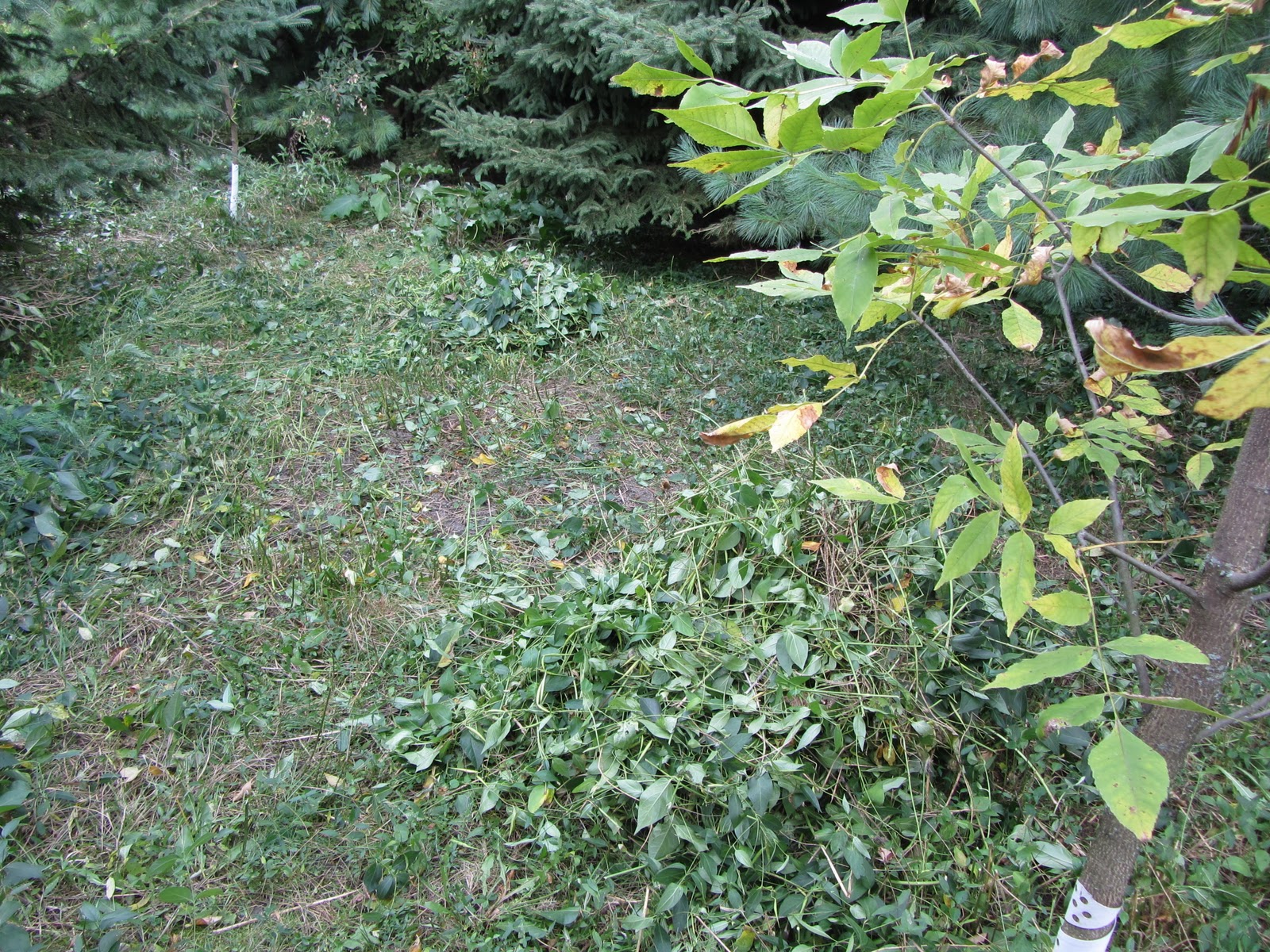
With all other volunteers out of commission for various reasons, Geoff bravely soldiered on on his own. The northern section of the Old Field had been mowed by AAFC, at Christine's request, at the end of last week. Geoff had intended to continue the cutting begun nearby in the Ash Woods, but found a patch of DSV near the mowed area. 

NE corner of the Old Field, before cutting...
This patch had been cut before and had regrown to the point that it needed another round. Geoff got much of it, as evidenced by the stack of cuttings left behind for disposal by AAFC.


...and after.

The results.


Wednesday, October 5, 2011

WEEK 23, October 4


Barry, Geoff, Hedrik, Christine

We tackled two areas today, the field south of the pond where we worked the past couple of weeks, and a new area, a section of the Ash Woodlot right at the end of Green Heron Road. In the area near the pond, Geoff recut a patch just east of the trail running south from the bridge to Green Heron Road, while Hedrik and Barry tidied up in the southeast corner of the field itself. Eight bags of DSV were left at the roadside for AAFC pick-up. Our natural history moment came in the form of a praying mantis, probably Mantis religiosa, quite a rare sight:

 
 When we reached the new area around break-time, a debate broke out as to the merits of cutting plants that are still green and growing versus plants that are yellowing and preparing to release their seeds. One side argued that more damage would be done to the green plants if they were cut over the yellowing plants, which had already sent nutrition down into the roots for next year's growth. The other side noted that a key objective was removal of seeds from the seed bank. Christine happened along at this point to do some work in the Old Field, the northern section of which is scheduled to be cut by AAFC in a couple of days. Ever wise, she noted that both sides had valid points. Fortunately, the area being contemplated had both kinds of growth, so off the scythers went to do their damage, whatever it might come to. Christine had come in on her own earlier in the week, so with her work then and the work today, another 14 bags of DSV were soon piled up. Grand total for the day, 22 bags. We'll continue with this area next Tuesday.


Before and...

after - two views from the Ash Woodlot.


Tuesday, September 27, 2011

WEEK 22, September 27


Barry, Geoff, Hedrik, Marg

Today was a rather frustrating experience, as we all dealt with the bagging of mulched and newly cut DSV in the field south of the pond. Geoff completed the bagging in the area he had scythed on Saturday then joined the rest of us in cleaning up. The south slope of the pond already had some piles ready for bagging, but other loose materials from previous cuttings needed to be raked up and bagged as well. The central part of the larger field south of the pond trail was our main focus. Tidying this up was pretty hard work, as the mulched DSV was reduced to long, hardy vines mixed with new growth that was difficult to cut. But at the end of the morning, 28 bags were waiting along the Green Heron Road for pickup by AAFC.

View of east side of the field.
View from the bridge - the group was all over that field! The orange bush in the pond is the water willow, most of which was removed on Friday afternoon as noted below.


Friday, September 30: Barry came in for a shift that had little to do with the usual TISG activities. He spent some time with a group working in the Butterfly Meadow. There is still some DSV there but his main task was getting a section ready for tilling. After lunch, Barry, Brian and Diane worked for an hour or so on invasives in the pond. Brian and Diane put on chest-waders and braved the mucky bottom, filling buckets with frog-bit and flowering rush that Barry emptied into a wheelbarrow for carting off to dump on unsuspecting DSV. One way to solve the mulch issue! Four barrow loads with 5 or 6 bucketsful each totted up to quite a bit of material being removed. About 30 Black and Mallard ducks didn't seem to mind our being there - they still had lots of duckweed left and we were an improvement over the crazed mutt that was braying and chasing them earlier in the day.

Thursday, September 22, 2011

WEEK 21, September 20


Barry, Geoff, Hedrik, Marg

It was great to have as many as four of us out again after a few weeks of reduced numbers. Geoff took time out from his vacation to join us and so off we all went to the New Woods to continue our efforts at recutting. Hedrik had come in on Sunday to do some cutting, so we had piles of DSV from Friday and Sunday to bag up, while Geoff continued cutting and bagging in his favourite spot, the northwest corner backing onto Green Heron Road.

At break we had quite a discussion about the phenomenon Hedrik noted last week, that DSV is growing along the ground under the first-year burdock leaves in a large central patch. These plants appear to be weaker in terms of stems and more prolific in terms of pods. They are almost invisible beneath the burdock. Hedrik has been working on this now for the last three or four sessions, and sparked our discussion with speculation on the possible evolutionary reasons why DSV might grow in this way. This kind of discussion reminds us how little we know about this plant and helps frame questions for further thought and research.
The trail of bags...
Marg caught in the act
Hedrik pondering DSV growth patterns...


Our efforts resulted in 26 bags of DSV piled up behind the barn, where AAFC can easily leave a wagon for loading on Friday. 


Barry took a walk around FWG to see how things stand as our season winds down. The TISG has accomplished an amazing amount of work, with most major areas showing green rather than the yellowing vines of DSV with their fluffy white parachutes. These can still be found in various pockets, the southern part of the Old Field being the largest and worst of these. Most of these pockets are too advanced to deal with this year, but several areas, especially in the Ash Woods and the Ravine, are still susceptible to being cut. Weather is becoming a factor as are fall schedules, but we'll continue into early October at least.

Monday, September 19, 2011

Friday, September 16

Barry and Hedrik returned to continue working in the New Woods and the field south of the pond. We decided today was one for cutting, leaving the bagging for next Tuesday. Hedrik worked his way west toward the barn, cutting DSV around the fir trees that separate this area from the central 'valley' of the New Woods. He continued around and down into the large patch of burdock he was working on earlier. Barry worked either side of the trail running south to Green Heron Road. After break, both of us worked on the western half of the pond's south slope and the field south of that. Hedrik also gave a much-needed cut to an small, overlooked patch on the west end of the pond near the willow. (We really do need to develop some code for the many different areas of the FWG!)

Hedrik's trail of destruction.
The burdock patch...

South slope of the pond after cutting.
Glenda is doing some research into DSV and posted a DSV Facts note that brought to our attention some important new findings regarding the consequences of using DSV as mulch. We've been doing this ever since we started cutting it, only bagging consistently in the past few weeks. Turns out we should have been bagging all along, as DSV continues to take a toll even as a mulch, providing leachates that discourage growth of other plants. Is there no end to the pernicious survival strategies of this plant? Apparently not! In a way, it's welcome news, as the issue of when to start bagging is clarified and we can in future avoid a big problem resulting from mulch, i.e., the increased difficulty in subsequent cuttings. We will no longer have to worry about predicting whether mulched vines will release their seeds - the pods on cut vines dry out faster - and inadvertently releasing them ourselves when our scythes crash into the decaying vines as we cut renewed growth. We've always understood that this year is experimental; here's an excellent example of new learning resulting in revision of our techniques.

Sunday, September 18, 2011

More DSV Facts

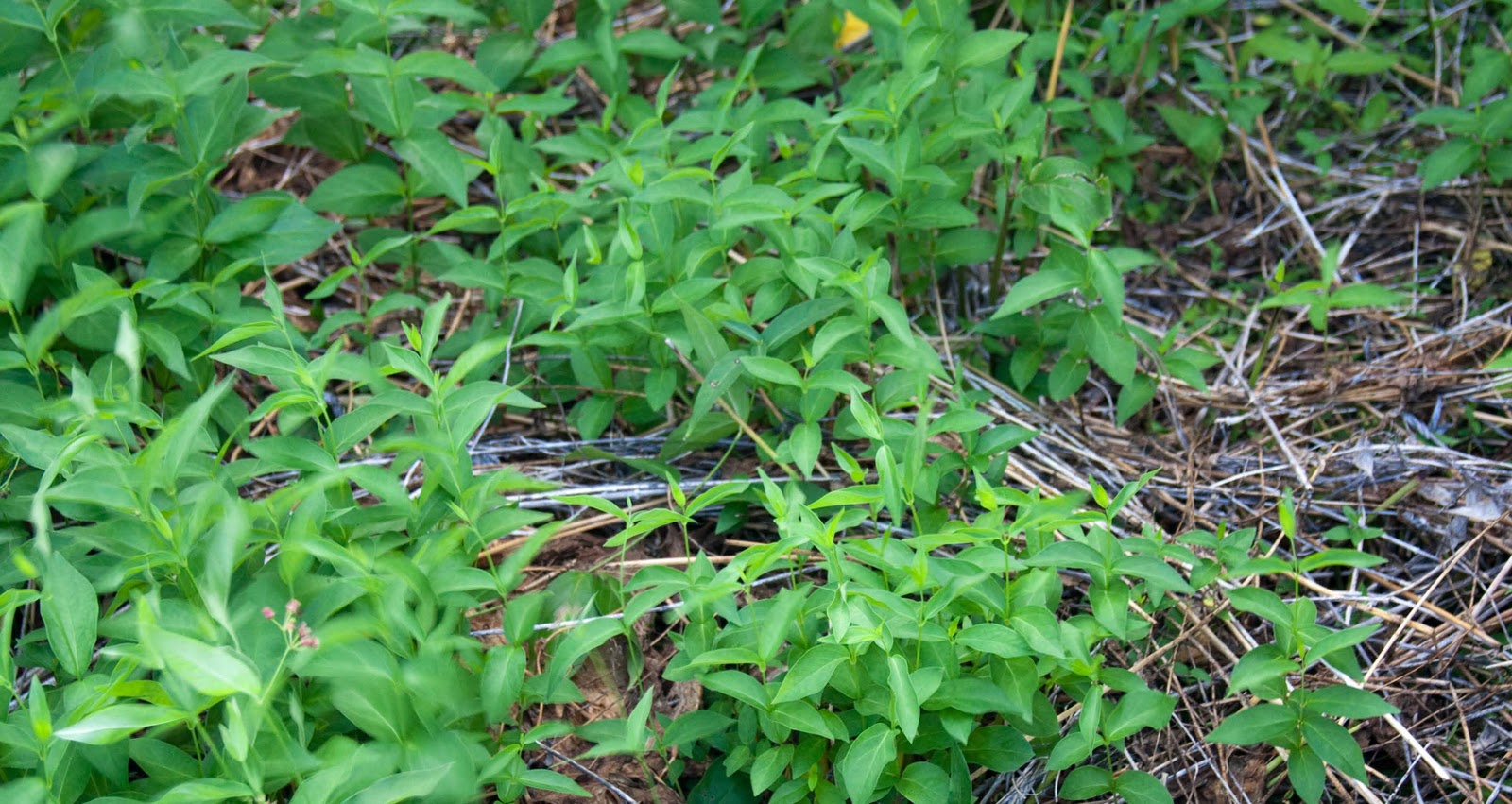
We certainly know that Dog-Strangling Vine (DSV or Cynanchum rossicum) is extremely good at reproducing by seeds.  Now, research is shedding light on yet another weapon in DSV's arsenal of self-protection.

It appears that tissue leachates and root exudates are detrimental to the seed germination and growth of other species.  In other words, when the plant stems and leaves decompose, they give off biochemicals that deter the growth of other plants. Biologists know these effects as phytotoxicity and allelopathy.  Further study is needed to understand the extent of the effect, but on the surface this appears to be something to be cautious of.  (Source:  Invasive Plant Science and Management)

This would mean that cut DSV should be removed and disposed of, rather than keeping it around as mulch in the hopes that it might inhibit further DSV growth.  As it turns out, we had already realized that re-cutting areas where the DSV was left as mulch was quite a challenge and so had begun removing cut DSV.  In any case, DSV control continues to be elusive.

Thursday, September 15, 2011

WEEK 20, Wednesday(!), September 14

Volunteers: Barry, Hedrik

Owing to threatening weather on Tuesday, we postponed until Wednesday the 14th. The bad news is this cost us Marg's contribution, as she couldn't come that day. As it turned out, the rains held off until later Tuesday afternoon, although the downpour helped in that pulling from wet soil is easier. We returned to the east central part of the New Woods, the area of our first efforts in May - what a near jungle it has become! Early removal of DSV seems to have encouraged the growth of many other plants, including such other invasives as comfrey, burdock and Canada thistle.

Hedrik made the disconcerting discovery in a large patch of young burdock that DSV spreads out along the ground, almost hidden from view by the spreading burdock leaves, and concentrates on seed production at the expense of strong stems

Hedrik pulling the hidden DSV.
This experience will have us rethinking early cutting. In the past, late June has been recommended as the time to start cutting. A couple of months are lost, however, so we started cutting on May 17, with recutting part of the plan. Rather than waiting, the big lesson might be increased diligence in assessing cutover areas. The New Woods is rather out of the way - you have to go there, rather than walk past it to get somewhere - so this is one to plan better next year.


This is only a portion of the fence...
In addition to the New Woods, DSV was scythed and pulled in the Hedgerow. This long, narrow area has not been treated systematically yet, so there was quite a bit of DSV growing up into the trees. The worst was discovering that almost the entire chain-link fence around the ball diamond has DSV growing straight up it, so many pods releasing seeds that it cannot be worked.


Tackling DSV is hard work, so the natural history breaks we usually get are always welcome. Of several this day, the discovery of a couple of large puffballs, both, oddly enough, right at the opening of ground-hog burrows, was the most interesting. As well, we were briefly supervised by our little buddy on the comfrey leaf and a couple of times watched a hummingbird flitting around the jewelweed.

In the early afternoon Barry did some additional 'gleaning' near the Interpretation Centre, trying to catch plants that were missed in previous efforts. There is always more DSV, it seems! An additional bag was enough to call it a day. In all, eleven bags were collected and piled up for AAFC to remove.

Tuesday, September 13, 2011

SUNDAY, SEPTEMBER 11: FOURTH BLITZ DAY

This fourth and final work bee turned out to be very much like the third: 14 people came out, worked very hard, and cleared a difficult area that the regular TISG would not have able to get to. As with all our bees, some familiar faces - including half the TISG - were seen along with several new people.


This week's 'newbies' included a family of three whose high school student member was working on her community service contribution. We continued along the Bill Holland trail, picking up where the third bee ended, at the section between our main sign and the bridge.


BEFORE


AFTER


We worked on both sides of the trail, as can be seen in Glenda's photographs. A couple of FWG regulars also worked in the ravine, just down from the Interpretation Centre. Everyone took to the task with a will, resulting in 33 bags - stuffed to the limit - of cut and pulled DSV.


During break it occurred to me to note that with DSV seeds now being released, we should all check our clothing and shoes to make sure that we're not carrying any away to be inadvertently spread elsewhere. This is an important vector for transmission here at FWG, not just for volunteers but for all those dogwalkers and their furry, seed-collecting charges. The conversation took other turns, however, and I forgot to raise the point. I'm making it now owing to the surprise I had when I got home: no fewer than 6 fluffy parachutes, seeds still attached, were clinging to my pant legs. They're now safely in an envelope and I'm considering potting them up to see what happens over winter.

Our relationship with AAFC is now more efficient; we now have the contact info and are arranging directly to have piles of DSV picked up. This can mean planning ahead to have a wagon available for us or arranging for a wagon to be left where by the piles so that we can load it up. The arrangement we had for the work bee was that a wagon would be parked so that we could load it on Tuesday. On Monday, however, AAFC employees came by with the wagon and loaded it themselves, sparing us some hard labour. As it turned out, with inclement weather threatening, we cancelled Tuesday the 13th, electing to come instead on Wednesday. It's that time of year again...

Wednesday, September 7, 2011

WEEK 19, September 6

Volunteers: Barry, Hedrik, Marg
 
We all continued in the final field north of the Ash Woods, the goal being to finally finish it off. This we did, apart from some residual cleanup, Barry and Hedrik scything and Marg restoring the banks of dogwood by clipping out the DSV. The field is named for this bush and it's good to be giving it the opportunity to show itself again. A row of cedars along the trail was also cleared of climbing vines.


Seed pods are really exploding now, so all the cuttings for today were bagged, with a total of 18 huge, stuffed bags added to the existing heap.

A couple more toads were rescued and Marg spotted another large paper-wasp nest, on the canal side of the trail and safely high up in a tree. Barry took a photo of it and the bags.

Paper wasp nest


Next week we'll return to our original stomping grounds, the New Woods. Hedrik has noted how overgrown it's getting, so it's time to deal with it once again.