Showing posts with label Swallowwort. Show all posts

Thursday, September 22, 2011

WEEK 21, September 20


Barry, Geoff, Hedrik, Marg

It was great to have as many as four of us out again after a few weeks of reduced numbers. Geoff took time out from his vacation to join us and so off we all went to the New Woods to continue our efforts at recutting. Hedrik had come in on Sunday to do some cutting, so we had piles of DSV from Friday and Sunday to bag up, while Geoff continued cutting and bagging in his favourite spot, the northwest corner backing onto Green Heron Road.

At break we had quite a discussion about the phenomenon Hedrik noted last week, that DSV is growing along the ground under the first-year burdock leaves in a large central patch. These plants appear to be weaker in terms of stems and more prolific in terms of pods. They are almost invisible beneath the burdock. Hedrik has been working on this now for the last three or four sessions, and sparked our discussion with speculation on the possible evolutionary reasons why DSV might grow in this way. This kind of discussion reminds us how little we know about this plant and helps frame questions for further thought and research.
The trail of bags...
Marg caught in the act
Hedrik pondering DSV growth patterns...


Our efforts resulted in 26 bags of DSV piled up behind the barn, where AAFC can easily leave a wagon for loading on Friday. 


Barry took a walk around FWG to see how things stand as our season winds down. The TISG has accomplished an amazing amount of work, with most major areas showing green rather than the yellowing vines of DSV with their fluffy white parachutes. These can still be found in various pockets, the southern part of the Old Field being the largest and worst of these. Most of these pockets are too advanced to deal with this year, but several areas, especially in the Ash Woods and the Ravine, are still susceptible to being cut. Weather is becoming a factor as are fall schedules, but we'll continue into early October at least.

Sunday, September 18, 2011

More DSV Facts

We certainly know that Dog-Strangling Vine (DSV or Cynanchum rossicum) is extremely good at reproducing by seeds.  Now, research is shedding light on yet another weapon in DSV's arsenal of self-protection.

It appears that tissue leachates and root exudates are detrimental to the seed germination and growth of other species.  In other words, when the plant stems and leaves decompose, they give off biochemicals that deter the growth of other plants. Biologists know these effects as phytotoxicity and allelopathy.  Further study is needed to understand the extent of the effect, but on the surface this appears to be something to be cautious of.  (Source:  Invasive Plant Science and Management)

This would mean that cut DSV should be removed and disposed of, rather than keeping it around as mulch in the hopes that it might inhibit further DSV growth.  As it turns out, we had already realized that re-cutting areas where the DSV was left as mulch was quite a challenge and so had begun removing cut DSV.  In any case, DSV control continues to be elusive.

Tuesday, September 13, 2011

SUNDAY, SEPTEMBER 11: FOURTH BLITZ DAY

This fourth and final work bee turned out to be very much like the third: 14 people came out, worked very hard, and cleared a difficult area that the regular TISG would not have able to get to. As with all our bees, some familiar faces - including half the TISG - were seen along with several new people.


This week's 'newbies' included a family of three whose high school student member was working on her community service contribution. We continued along the Bill Holland trail, picking up where the third bee ended, at the section between our main sign and the bridge.


BEFORE


AFTER


We worked on both sides of the trail, as can be seen in Glenda's photographs. A couple of FWG regulars also worked in the ravine, just down from the Interpretation Centre. Everyone took to the task with a will, resulting in 33 bags - stuffed to the limit - of cut and pulled DSV.


During break it occurred to me to note that with DSV seeds now being released, we should all check our clothing and shoes to make sure that we're not carrying any away to be inadvertently spread elsewhere. This is an important vector for transmission here at FWG, not just for volunteers but for all those dogwalkers and their furry, seed-collecting charges. The conversation took other turns, however, and I forgot to raise the point. I'm making it now owing to the surprise I had when I got home: no fewer than 6 fluffy parachutes, seeds still attached, were clinging to my pant legs. They're now safely in an envelope and I'm considering potting them up to see what happens over winter.

Our relationship with AAFC is now more efficient; we now have the contact info and are arranging directly to have piles of DSV picked up. This can mean planning ahead to have a wagon available for us or arranging for a wagon to be left where by the piles so that we can load it up. The arrangement we had for the work bee was that a wagon would be parked so that we could load it on Tuesday. On Monday, however, AAFC employees came by with the wagon and loaded it themselves, sparing us some hard labour. As it turned out, with inclement weather threatening, we cancelled Tuesday the 13th, electing to come instead on Wednesday. It's that time of year again...

Wednesday, September 7, 2011

WEEK 19, September 6

Volunteers: Barry, Hedrik, Marg
 
We all continued in the final field north of the Ash Woods, the goal being to finally finish it off. This we did, apart from some residual cleanup, Barry and Hedrik scything and Marg restoring the banks of dogwood by clipping out the DSV. The field is named for this bush and it's good to be giving it the opportunity to show itself again. A row of cedars along the trail was also cleared of climbing vines.


Seed pods are really exploding now, so all the cuttings for today were bagged, with a total of 18 huge, stuffed bags added to the existing heap.

A couple more toads were rescued and Marg spotted another large paper-wasp nest, on the canal side of the trail and safely high up in a tree. Barry took a photo of it and the bags.

Paper wasp nest


Next week we'll return to our original stomping grounds, the New Woods. Hedrik has noted how overgrown it's getting, so it's time to deal with it once again.

Friday, August 19, 2011

WEEK 16, August 16 & 18

Tuesday, August 16

Volunteers: Barry, Glenda, Geoff, Hedrik, Christine, Marg


We continued working in the fields just north of the Ash Woods and made good progress again. This area is tough going, with bent over DSV, lots of bushes and trees and patches of goldenrod. But we had quite a stack of cut plants by the end of the morning. We're beginning to bag it up now, as seeds are being released. DSV seems to release seeds first closest to the ground, so sometimes we don't see them until the plants are cut and moved. It's still better to take out this material, as the seeds left behind are far fewer than those that would be there if nothing was done.

The four of us returned to the IC for our break so that we could have a discussion of our work to date, future goals and how the group is changing over the next while. Glenda is returning to work, so this is most likely her final Tuesday with the group. She has worked very hard and diligently, often the first to arrive and last to leave, so she'll be missed! Barry is away next week and Geoff will be gone the first 3 weeks of September. We took a look at the map and could see where we've been and what's left to do. The upshot of the discussion is that we'll try when we can to make up some of the time that will be lost by coming in as we can at other times.

BEFORE


AFTER
Christine and Marg worked in a couple of sections of the Old Field, continuing to pull and clip DSV from among the various other plants. They are finding too that seeds are being released and that bagging is becoming an unfortunate necessity.


Thursday, August 18: Barry and Hedrik came in this morning and spent a couple of hours in the hot sun continuing in the central field north of the Ash Woods. Both of us scythed away, managing to avoid the large paper-wasp nest - now marked by a warning sign - and created a new heap of cut DSV plus at least half a dozen bags. We made good progress, but two hours was enough!

Wednesday, August 17, 2011

WEEK 15: August 12 & 13

Friday, August 12: Barry came in for a regular shift that turned out to be anything but. A couple of weeks ago, a new invasive was discovered in the BYG; it became the subject of discussion last Friday, when it was identified as Dodder. This is a very strange plant, a parasite that lives entirely on host plants; in fact, it dies if it cannot find a host within a day or two of germinating. As well, Barry and Sandy had arranged to spend some time Friday morning removing frog-bit from the Pond. The upshot was less time spent on DSV.

Barry did some recutting in the pond area. This was more difficult than anticipated, largely owing to the layer of mulch, i.e., previously cut DSV left behind. It's difficult to keep the scythe out of this, which kicks it up, and harder to cut the new growth. So our practice of piling cut DSV is proving to be a good one and it's necessary to rethink the mulching theory.

A tour around the Butterfly Meadow, site of the first two work bees, and the fields to the east we've been recently cutting revealed new growth already springing up. The BM has new plants coming up and in the field, cut stems are sprouting vines at their leaf nodes. It was discouraging to see long stems with as many as 8-10 nodes, each with a vine coming on.

Saturday, August 13: Geoff was unable to make the Sunday work bee so came in this morning instead. He continued scything around the row of tamaracks, working his way in the direction of the Ash Woods and again producing a large heap of cut DSV.

WEEK 15, August 9

Volunteers: Barry, Geoff, Glenda, Christine, Marg

The idea was to start in the first of three fields north of the Ash Woods, the one on the west side of the trail that runs along the west side of the Woods then curves around to the east. Geoff worked in this area, starting just below the curve and working his way around it, ending up on the east side of the row of tamaracks that separate this shrubby area from the middle field.

Glenda and Barry intended to work directly with Geoff but discovered that there was a good deal of DSV in the southern end of the field worked on last week. Glenda continued working there, pulling copious vines out from among the sumacs and other bushes, while Barry worked in even denser ground across the trail from her.

This is the transition point, where the Ash Woods ends and the dense shrubs and trees of the new work area begin. The scythe reached its limit in this area, and the clamp holding the blade to the snath fell apart. It was a hard day for tools, as Geoff found his rake in pieces too. The good news was discovering that a pitch fork is a pretty handy device for stacking cut vines. After a hard morning's work, Glenda stayed behind to take photographs for the blog.
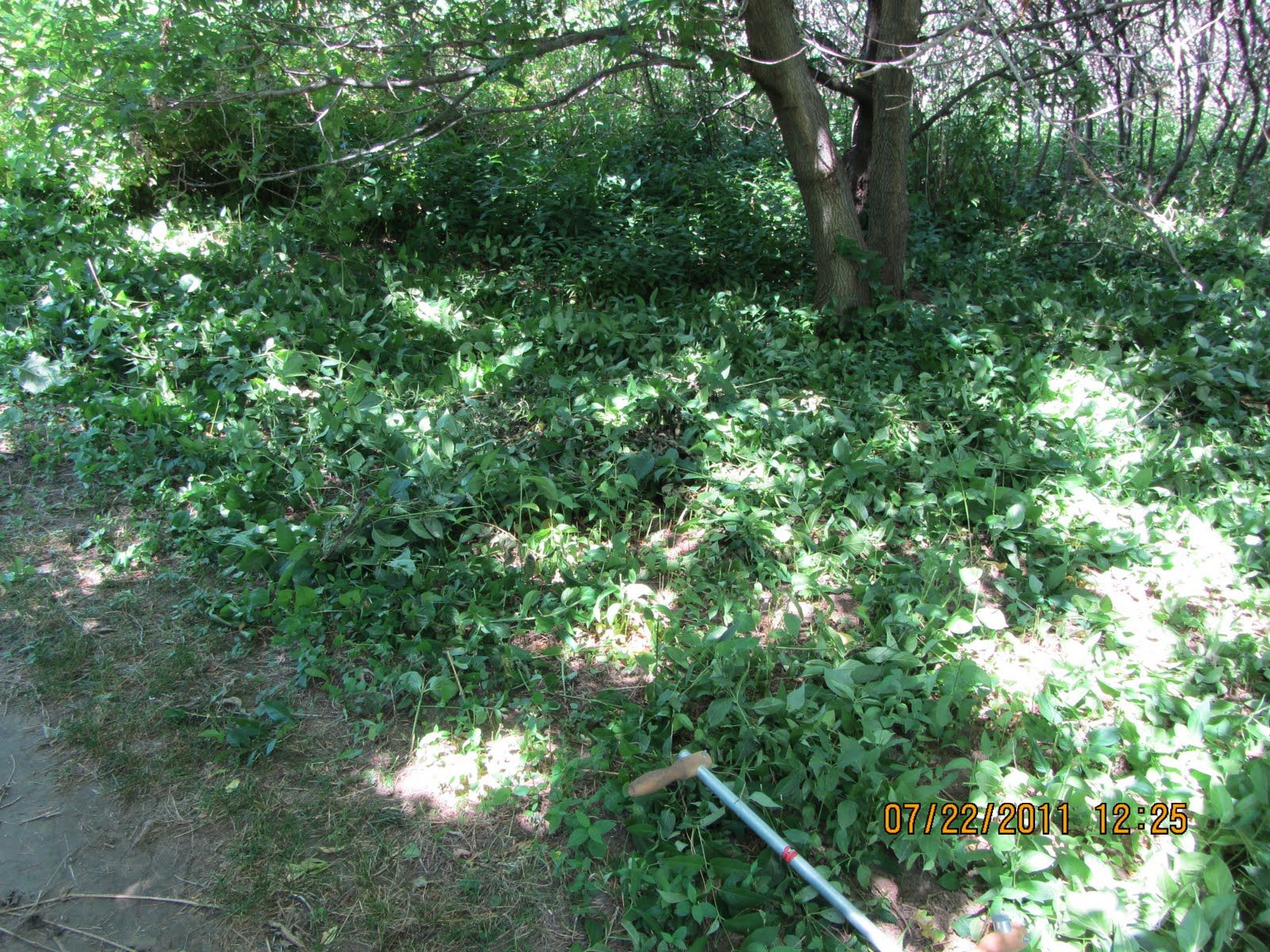
Christine and Marg continued in the Old Field, weeding DSV out from among the beneficial plants in the northeast corner. At Christine's suggested, the decision has been made to mow half of the Old Field at the end of the season, i.e., in October, but the area to be mowed does not have a lot of DSV in it. The other half will be mowed in October 2012.


Thursday, August 4, 2011

A Hero in the Battle of Invasive Species

As bad a Dog-Strangling Vine (DSV) is, we have to be so grateful that Kudzu is not a problem in the Ottawa area.  

Kudzu is a terribly aggressive invasive in the US and now in some areas of Canada (e.g. Lake Erie).  Originally from Japan, it was once thought to be an erosion control solution in the States.  Now, it has gotten out of control.  It grows up to 30 centimetres a day, blanketing everything in its path, including hydro poles, fences, houses and highway signs.  Control has been extremely difficult and expensive.   

And now, here is a 16 year old guy with a solution, the "Kudzu Kid".    Originally, Jacob Schindler had hopes of making his mark by growing Kudzu on Mars.  When he realized that wouldn't work because of the amounts of helium on Mars, the wheels started turning and he tried injecting helium into the tuberous roots of Kudzu.  Zap.  Success.  Patents are pending.  Experiments are running.  Looks like this is working. 

Maybe Jacob will turn his mind to DSV?

Friday, July 29, 2011

WEEK 13, July 26

Volunteers: Barry, Geoff, Glenda, Hedrik, Christine plus 7 members of the Heffner family.

The Heffners joined us this week, volunteering as a means of off-setting the environmental costs of their trip from Michigan. This is an admirable idea and they were with us for about 2 hours, until our morning got called by an incredible thunderstorm. The Heffners worked along the part of the Bill Holland trail closest to the IC and on the ravine side, then moved briefly to the field east of the Butterfly Meadow. Their main activity was clearing DSV from around and in the trees, sumacs along the trail and cedars in the field.


While Barry was with the Heffners, Glenda, Geoff and Hedrik returned to the Green Heron road to continue last week's work, along the road toward the Butterfly Meadow. AAFC had picked up the stacks of DSV cut last week and now have more to pick up.


Christine continued her work in the Old Field and also along the fence on the north slope of the Amphibian Pond.   Geoff then switched to the field east of the Meadow.  Glenda and Barry and the Heffners joined him there for the last half hour. We made good progress on this field and we should be able to finish it next week. After that, it's on the fields north of the Ash Woods.


Wednesday, July 27, 2011

The Heffner Family Gives Back to the Environment


This week we had the pleasure of having the Heffner family from Grand Rapids, Michigan work with us in our efforts to control Dog-strangling Vine (DSV).  Pictured above are Ken and Gail Heffner with Daniel Heffner, Andrew Heffner, Morgan Stewart, and Elisabeth Heffner. 

The Heffners were in town on vacation, visiting son Daniel who is a grad student here in Ottawa.  Aware of the environmental impacts of their travel, they try to offset these when travelling by giving back in some way to the community they are visiting. 

They found out about the Fletcher Wildlife Garden (FWG) and the struggle to control Dog-strangling Vine.  DSV is a highly invasive species that thrives in sun or shade and in any type of soil.  It spreads rapidly, choking out other plants and even trees in the area.  It is pervasive throughout FWG, and volunteers have been busy trying to control the spread of seeds and stem the spread of DSV into areas that are not yet heavily invested.

Upon arrival, the Heffner family enthusiastically got suited up with work gloves and dug right in, so to speak!  


In the couple of hours they gave to FWG, they were able to make a real difference.  First, working along a busy pathway and then moving on to an open area where they were able to free up several trees and shrubs that had been covered with DSV.   We all watched the dark clouds coming in and they gamely kept right on working up until the clouds broke.  Torrents of rain soon came down while we took shelter in the Interpretation Centre.


At FWG, no matter how much hard work is to be done, there is always time to see some wildlife and learn from the many knowledgeable nature lovers around.   Among other things, the Heffners were able to observe a young Green Heron at the Amphibian Pond (photo below) and a crab spider that has been hanging out on a common milkweed plant.   


The Heffners set a wonderful example of environmental stewardship and community involvement.  What a great way to give back when visiting friends and family out of town.  Many thanks to the Heffners and safe travels to you all!


Monday, July 25, 2011

Friday, July 22

Barry scythed an area very close to the Interpretation Centre (IC), between the Bill Holland trail and the driveway to the IC and just opposite the leaf mulch compound. Several reasons for this choice: it was another hot day and this area is shaded; but it was also a chance to get a feel for what's it's like working among the sumac. This is a possible task for the Michigan family that will be working with us on Tuesday next. Barry and Barbara Riley cleared DSV from the compound fence, the second time this has been done. The first time was June 10, and the DSV was not quite as tall but already developing pods. Barry also did some clearing around the trees just to the west on the north edge of the lawn. The slope there had been mowed a couple of weeks ago by AAFC, and already DSV shoots are sprouting up.


After break, Barry went to clear up the last mounds of DSV cut on Sunday; these were spread out among the sumac there. A row of cedars separates this north east section of the Butterfly Meadow from the area immediately to the east bounded by the north-south trail running on the west side of the Ash Woods. Barry cut DSV at the edges of these trees, ripping vines down from their branches. This area is heavy with DSV and is a good candidate for more work. It and related areas to the east, along with the southern portion of the Old Field, are the last large, heavily infested areas.


The map has been updated to show this work.


WEEK 12, July 19

Volunteers: Barry, Hedrik, Geoff, Glenda, Marg
We've decided to consolidate the areas we've been working on and then evaluate where we are at this mid-point for the season. A check on Monday afternoon revealed some places that needed work in order to complete several areas. These included spots along the trails running south from the bridge and the southeast section of the field south of the pool. Three of us scythed away while Glenda and Marg clipped and pulled around the trees. Here are some before / after pictures showing the progress.
BEFORE
AFTER

A small tree is hidden by DSV - can you find it?

The small tree once freed from DSV


The upshot was that we completed these areas, with the exception of a small corner near the barn where an active bird nest is huddled low to the ground in one of the spruces. Glenda found the nest last week and immediately stopped working near it. The nest had eggs then and perhaps four altricial chicks this week.

The trails run from the bridge, forming a triangle as they reach Green Heron road. The eastern trail curves into and through the butterfly meadow, the western between the main field south of the pond and the western side of the meadow. Much of this triangle was cut over this week, so now we have contiguous cutting all along Green Heron road, with the exception of the small area at the west end where the nest was found.

Barry has completed the map, sketching in and confirming the various trails and marking areas cut and areas remaining to be worked on. The main areas remaining are all along the Bill Holland trail from the IC to the bridge, the southern part of the Old Field and the area north of the Ash Woods, sometimes referred to as the dogwood meadow. Both these latter areas are heavily infested and it may be that the best we can do is clear around the many trees and shrubs being overtaken by DSV. A final area is the west end of the New Woods, up to Prince of Wales and along the driveway into FWG, including the area between the Hedgerow and the ball diamond. This area is one that may have to be left alone, unfortunately.

Seed pods are changing colour and seeds are ripening up. We will need to monitor cut plants; hopefully we will not have to gather up these mounds of material scattered throughout the areas where we've been working.

More DSV Funnies


Two guys go golfing. One’s semi-pro and the other is his pretty lame beginner student. Both of them manage to knock a ball into a big fat patch of DSV. Which one has the best chance of hitting it out?

The beginner, cause he sure can slice!


I don't know about Barry's golfing abilities, but in a field of DSV, he is a master-slicer!

Wednesday, July 20, 2011

DSV Facts


Did you know......

Dog-strangling Vine (DSV) spreads by seed.  And, indeed, it most certainly does spread!


DSV can be pollinated by insects, but it has the handy little skill of self-pollinating.   It turns out, this is the best of both worlds.  When insects are around to pollinate, this increases the genetic diversity of the plants, making the DSV stronger and more resilient as a group.  Alternatively, when there are no insects to help it pollinate... well, no worries, it will do the job itself.  This plant will not be denied!

Several studies have shown that DSV plants growing in the shade produce fewer seed pods and fewer seeds per pod than DSV plants growing in sunny conditions.   This is something we have noticed at Fletcher Wildlife Garden also.   DSV has a habit of finding sun though.  In a wooded area, it will grow up through tree branches and find the sun that way.  Oh, and in ideal partial-sun conditions, around 30,000 seeds per square metre can be produced.

Polyembryony has been found to be "strongly evident" in DSV.   This means that the seed has two shots for success.  If the seed does not germinate because of weather conditions, it gets to try again with its spare embryo.  Did I mention that this plant will not be denied!

Most DSV seeds fall close to the parent plant, but some research has shown seeds spreading as far as 60 metres from the parent plant.  Not surprisingly, it is a pretty flexible germinator, too.  It tends to germinate after stratification (over-wintering), but some DSV seeds germinate just fine in the same season before winter even hits, and others can germinate two or three (perhaps more?) years later. 

Source:  Dog-Strangling Vine: A review of distribution, ecology and control of this invasive exotic plant


DSV at Fletcher Wildlife Garden

So what does it all mean?  Well, of course, it means that we do not expect to eradicate this plant.  We are however doing what we can to contain its spread.  The Tuesday Invasive Species Group (TISG) is focused on cutting down DSV plants before viable seeds are produced and cutting and removing plants with viable seeds.  It's a big job, but remarkably satisfying!

Visitors to FWG are reminded to brush off their clothing and their dogs' coats before leaving the site, to prevent bringing seeds home with them.


Wednesday, July 13, 2011

WEEK 11, July 12

Today's volunteers were Barry, Glenda, Geoff, Hedrik, Jean, Christine, and Marg.

Jean and her new billhook joined us today, her way of thanking FWG for the loan of the Weed Pullers. The billhook is like a cross between a machete and a sickle and is an effective tool for cutting off DSV in tight places, such as under trees and where single plants or small clumps grow in the midst of desirable plants. Jean cheerfully put in 4 hours at this and it's unfortunate she is not available for other Tuesday groups.


The rest of us continued with where we had left off last week, with Christine and Marg working in the Old Field (above), along Green Heron road, and the remaining four in the field south of the pond. Glenda had a large spot at the southeast corner, where the trail from the bridge meets GH road. She spent the morning pulling and clipping DSV from under the trees there (see before and after pictures below), rescuing some small trees that weren't even visible until released from their cover of DSV. She also continues to keep a photo record of our activities.


Barry, Geoff and Hedrik worked the scythes, finishing the clearing of this field back to the banks of trees that hide GH road. Geoff worked as well on the north side of GH road, eventually linking up with us in the main field. Geoff noted the difference in regrowth of DSV in areas where he had pulled DSV and Barry had scythed several weeks ago. This is the where the Purple Finch had nested in a spruce by the road, Geoff having worked on the west side and Barry on the east side of this spruce. Geoff's area showed much more growth of desired plants while Barry's was regrowing pretty much DSV. We wondered whether the difference was owing to difference in techniques and / or difference in original state. We also wondered if the difference would carry into next year.

We tried an earlier start this week, with five of us turning up at 8:00 and two coming later at 9:00. It was a hot and very humid day, hence the early start. We could also finish by 11:00 although several worked after that. The past few weeks have shown good progress, the group has hit its stride and we are pleased with how things are going. Many challenging days ahead, of course, but we continue to work toward minimizing seed production. Attention will be paid in the coming weeks to the progress of seeds, as bagging will be required once seeds are starting to distribute.