Showing posts with label Native Plants. Show all posts

Wednesday, July 13, 2011

WEEK 11, July 12

Today's volunteers were Barry, Glenda, Geoff, Hedrik, Jean, Christine, and Marg.

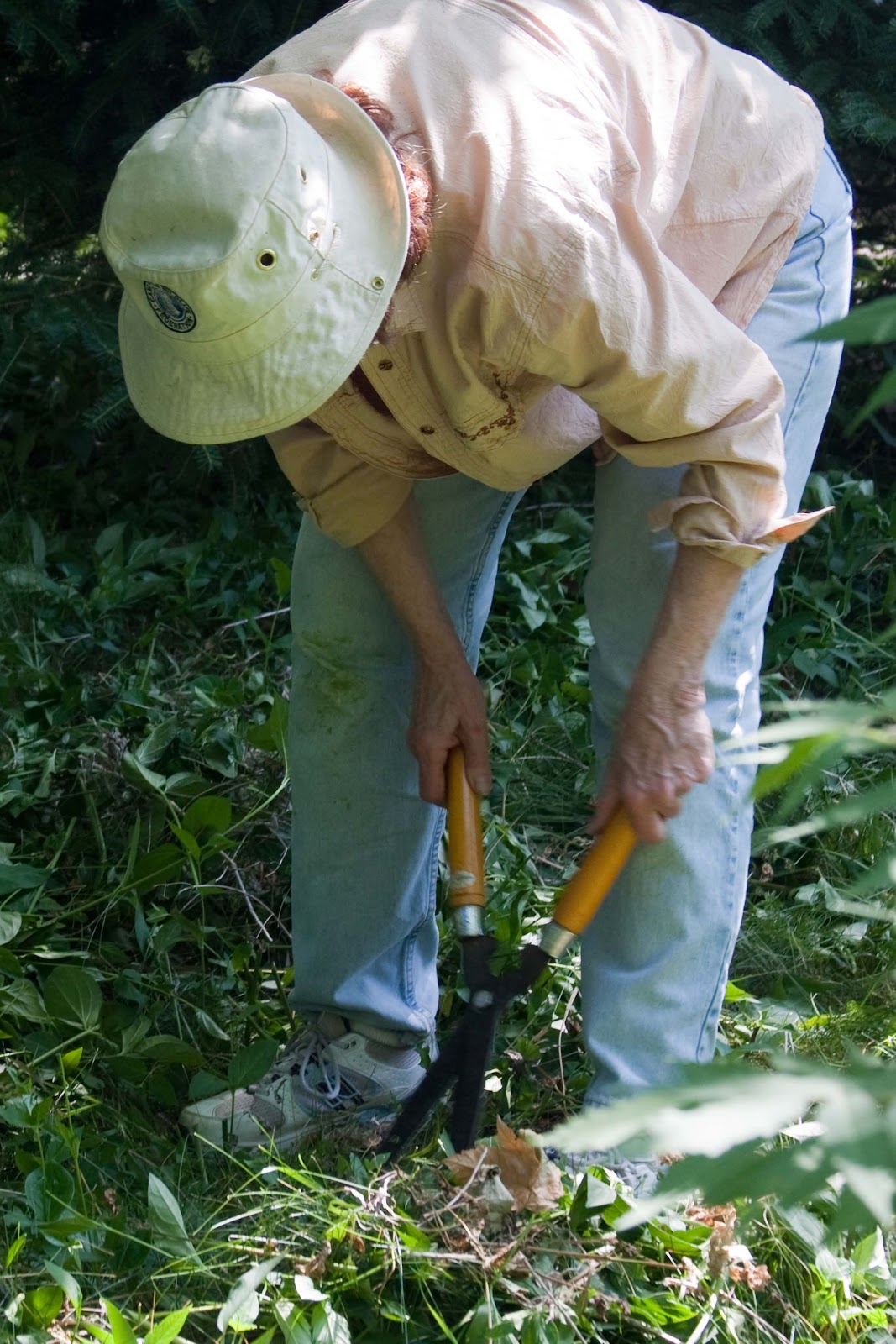
Jean and her new billhook joined us today, her way of thanking FWG for the loan of the Weed Pullers. The billhook is like a cross between a machete and a sickle and is an effective tool for cutting off DSV in tight places, such as under trees and where single plants or small clumps grow in the midst of desirable plants. Jean cheerfully put in 4 hours at this and it's unfortunate she is not available for other Tuesday groups.


The rest of us continued with where we had left off last week, with Christine and Marg working in the Old Field (above), along Green Heron road, and the remaining four in the field south of the pond. Glenda had a large spot at the southeast corner, where the trail from the bridge meets GH road. She spent the morning pulling and clipping DSV from under the trees there (see before and after pictures below), rescuing some small trees that weren't even visible until released from their cover of DSV. She also continues to keep a photo record of our activities.


Barry, Geoff and Hedrik worked the scythes, finishing the clearing of this field back to the banks of trees that hide GH road. Geoff worked as well on the north side of GH road, eventually linking up with us in the main field. Geoff noted the difference in regrowth of DSV in areas where he had pulled DSV and Barry had scythed several weeks ago. This is the where the Purple Finch had nested in a spruce by the road, Geoff having worked on the west side and Barry on the east side of this spruce. Geoff's area showed much more growth of desired plants while Barry's was regrowing pretty much DSV. We wondered whether the difference was owing to difference in techniques and / or difference in original state. We also wondered if the difference would carry into next year.

We tried an earlier start this week, with five of us turning up at 8:00 and two coming later at 9:00. It was a hot and very humid day, hence the early start. We could also finish by 11:00 although several worked after that. The past few weeks have shown good progress, the group has hit its stride and we are pleased with how things are going. Many challenging days ahead, of course, but we continue to work toward minimizing seed production. Attention will be paid in the coming weeks to the progress of seeds, as bagging will be required once seeds are starting to distribute.


Tuesday, July 12, 2011

July 12 Interim Update

We had a great morning going after DSV.  Check back later for more details.  In the meantime, here is a taste of what we did.  We turned this


into this


And, this tree (yes, there is a tree in there)
into this 


And, this


Is now this


If you haven't voted today for our Butterfly Meadow, be sure to VOTE here.

Monday, July 11, 2011

SUNDAY, JULY 10: FIRST BLITZ DAY

The blitz day - aka Weeding Bee - was a huge success!


About 25 people came out, including most of the TISG group, joined by Geoff's wife Judy, honourary member for the day. The main target area was in the Butterfly Meadow, between the tarp and the rail fence to the north. This is a large patch, with a lot of DSV mingling with many other plants that belong in the meadow. The group worked very hard, most people being there from 9 to about 1, with a mid-morning break at the Interpretation Centre.

The area was pretty much cleared of DSV, taken out entirely by pulling. This is proving to be the most efficient way of taking out DSV that is growing among other plants. Although the DSV stems seem to become more brittle as the plant matures, it was still quite easy to pull them out singly and in clumps without breaking them off. The pulled plants were carted to the sumac growing on the south side of the ravine, where they were used as a thick mulch. The understory of this extensive stand of sumac is almost entirely DSV; vines reaching up into the trees were torn down before armloads of DSV from the meadow were tossed on top. We'll need to monitor this for effectiveness. Several of us took photos, for both the TISG blog and the FWG blog.


Friday, July 8

Barry set off toward the pond but couldn't resist scything around the clump of trees growing by the old retaining wall across from where the Bill Holland trail comes out at the main FWG sign near the parking lot. He then spent about 1.5 hours continuing to scythe the areas south of the pond, i.e., the remaining patch on the south slope down to the pond and much of the remaining DSV in the west side of the field south of the pond trail. The plants are very tall, heavy with pods and twining around each other, pulling themselves over with the weight, making scything very difficult. Some still remains to clear. The good news is that several milkweed plants were braving it out in the midst of this heavy infestation. Before and after photos were taken. After break, Barry and Sandy had a good discussion on how things are going with the TISG. She has some good ideas in regard to databasing our photographs.

Friday, June 24, 2011

WEEK 8, June 21

The first day of summer was welcomed in by Barry, Glenda, Hedrik, Geoff, Marg and Isabelle at the Tuesday Invasive Species Group at FWG.

We decided this week to work closer together as a group and to take a scheduled break half way through rather than going off in small groups of 2 or 3 and taking breaks on our own, as we have done in the past couple of weeks. Our main work this week continued in the New Woods and the area south to Green Heron Road, as per our decision last week to revisit areas that had been cut before. Regrowth of DSV - as indeed its regular growth - has been phenomenal this year and it is denser than ever. Pods are already forming on plants in the best conditions (lots of sun) and these now have to become a priority.


Our specific activities included recutting with scythes and continuing to clip under and around trees. Geoff returned to the section he had been cutting three weeks ago.

Before Geoff's Work

By break time, Geoff had it all trimmed back again.


Hedrik and Barry worked in the New Woods proper, cutting as far as the western-most tarp. Hedrik has done a good job of clearing the Hedgerow path on the south side, from about the middle of the New Woods to its entrance at the ball diamond.


Glenda, Marg and Isabelle continued clipping and clearing around trees.


In addition to cutting and clipping, we rediscovered the virtues of pulling DSV up by the roots. This is arguably more effective than cutting in terms of setting back individual plants. In fact, the question was raised later and there has been some discussion of the relative merits of these techniques. While pulling is a good thing to do and will be the main technique in use during our upcoming work bees, scything remains the method of choice for cutting large areas quickly. It is simply not possible to pull large areas but it is very effective for plants growing singly and in small groups, especially where other plants we want to keep are competing against the DSV.

In between all the hard work, we also managed to squeeze in a relaxing break complete with getting to know a weevil that stopped by to hang out on Hedrik's arm and some bird watching along the way.

Saturday, June 11, 2011

Welcome to the Tuesday Invasive Species Group!

The Tuesday Invasive Species Group (TISG) began operations at the Fletcher Wildlife Garden on May 3, 2011. Several species of invasive plants have been encroaching on the Fletcher Wildlife Garden since its founding in 1991, with Dog-strangling Vine being the most serious of these.  Focused efforts against invasives are required if we are to have any success in dealing with them. The TISG has been established to provide that focus.

The group meets every Tuesday morning at 9:00 and works until about noon, with a break around 10:30 at the Interpretation Centre. We are engaged in physical removal of invasive plants, protecting trees through mulching, monitoring the growth and spread of invasives through photographing and mapping, and providing public education on invasives.

New members are welcome! Just turn up on a Tuesday morning and let us know how you would like to get involved.