Showing posts with label volunteer. Show all posts

Wednesday, September 7, 2011

WEEK 19, September 6

Volunteers: Barry, Hedrik, Marg
 
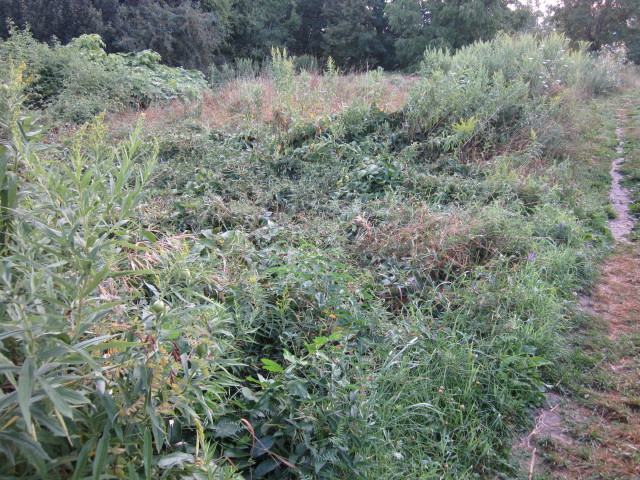
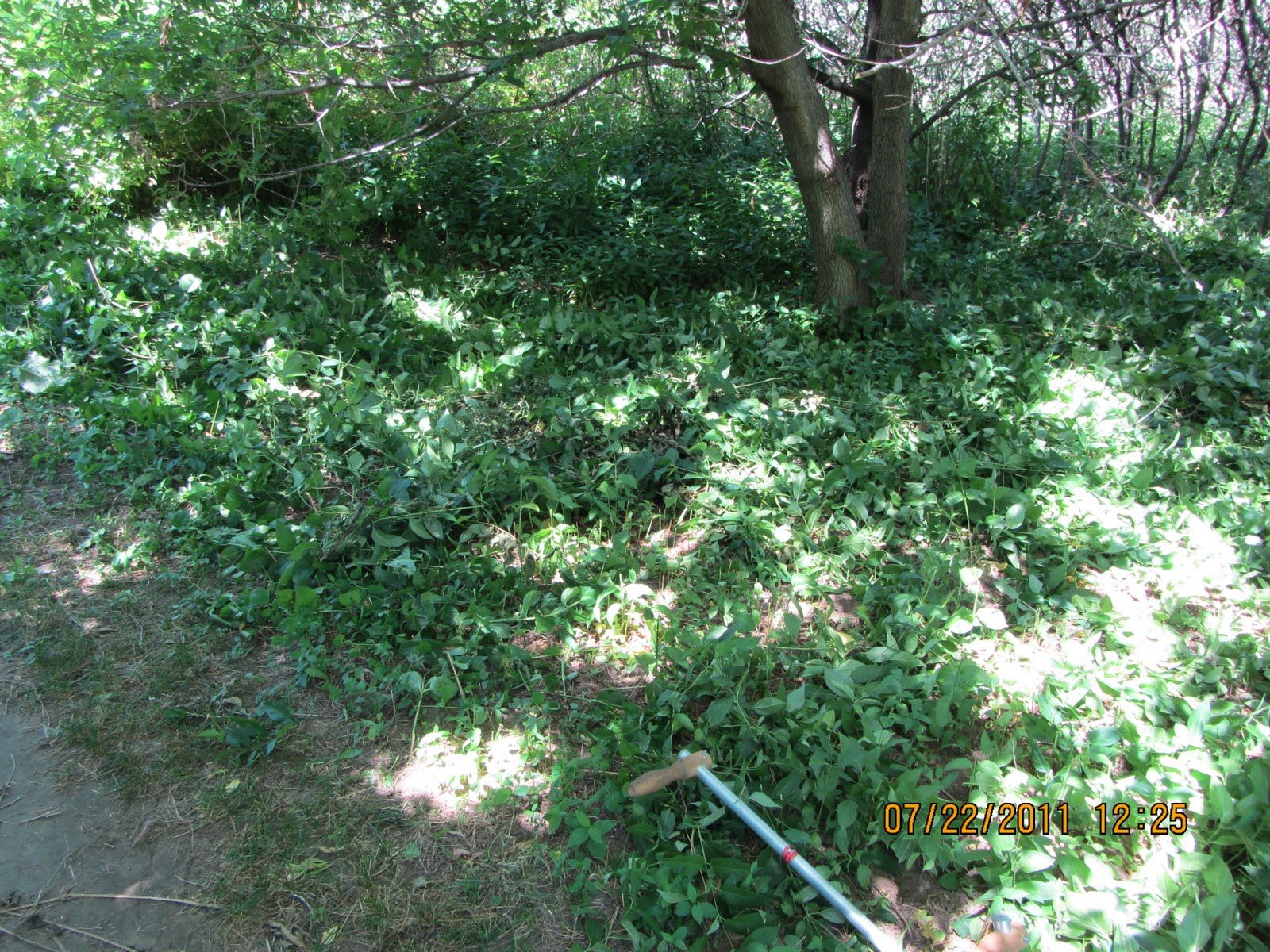
We all continued in the final field north of the Ash Woods, the goal being to finally finish it off. This we did, apart from some residual cleanup, Barry and Hedrik scything and Marg restoring the banks of dogwood by clipping out the DSV. The field is named for this bush and it's good to be giving it the opportunity to show itself again. A row of cedars along the trail was also cleared of climbing vines.


Seed pods are really exploding now, so all the cuttings for today were bagged, with a total of 18 huge, stuffed bags added to the existing heap.

A couple more toads were rescued and Marg spotted another large paper-wasp nest, on the canal side of the trail and safely high up in a tree. Barry took a photo of it and the bags.

Paper wasp nest


Next week we'll return to our original stomping grounds, the New Woods. Hedrik has noted how overgrown it's getting, so it's time to deal with it once again.

WEEK 18, August 30

Volunteers: Geoff, Barry, Christine, Marg


Geoff and Barry continued working in the field north of the Ash Woods. Christine and Marg continued their work in the north section of the Old Field. Showers had been predicted for this morning and, sure enough, by 9:45 it was too wet to work. Photos will have to wait for another day! Christine and Marg are bagging up the vines they are cutting, as they find too many seeds are being dispersed. Many seeds and, worse, parachutes without seeds, can be found on the ground, particularly in sunny areas, so we'll all need to start bagging up cut DSV. This will also make disposal easier as well as prevent even more seeds being released when AAFC comes to remove the cut plants.

Friday, September 2: Barry continued working in the area north of the Ash Woods, adding to the piles of cut DSV abandoned to the rain on Tuesday. A large patch of bushes that Glenda had worked so hard to clear has now been scythed around completely, but some work remains to be done, especially along the eastern-most trail through the Woods. Photos were taken for the database.

An apparent family of toads was disturbed by this work. After clearing some cut vines and with scythe in hand, Barry noticed a small toad trying to escape. It was caught and released in a safe spot further in the Woods. A second toad emerged, with the same result, and then a third was found. All were quite small, less than 50 centimetres in length. Number four was larger - perhaps 80-90 centimetres - and lighter in colour, but similarly patterned. All four were captured and transferred to the same spot, so hopefully will be fine. One never knows, of course. They appear to be American Toads (Bufo americanus), common to FWG. The other natural history note was discovery of a quite strange fungus; unlike the toads, it was photographed but has not yet been identified.

WEEK 17, August 23

Volunteers: Geoff, Hedrik, Marg


Geoff continued working in the field north of the Ash Woods, while Hedrik and Marg worked in the New Woods, returning to the first area worked by TISG. Geoff sent several photos of his efforts, which he continued on Saturday the 27th.


Friday, August 19, 2011

WEEK 16, August 16 & 18

Tuesday, August 16

Volunteers: Barry, Glenda, Geoff, Hedrik, Christine, Marg


We continued working in the fields just north of the Ash Woods and made good progress again. This area is tough going, with bent over DSV, lots of bushes and trees and patches of goldenrod. But we had quite a stack of cut plants by the end of the morning. We're beginning to bag it up now, as seeds are being released. DSV seems to release seeds first closest to the ground, so sometimes we don't see them until the plants are cut and moved. It's still better to take out this material, as the seeds left behind are far fewer than those that would be there if nothing was done.

The four of us returned to the IC for our break so that we could have a discussion of our work to date, future goals and how the group is changing over the next while. Glenda is returning to work, so this is most likely her final Tuesday with the group. She has worked very hard and diligently, often the first to arrive and last to leave, so she'll be missed! Barry is away next week and Geoff will be gone the first 3 weeks of September. We took a look at the map and could see where we've been and what's left to do. The upshot of the discussion is that we'll try when we can to make up some of the time that will be lost by coming in as we can at other times.

BEFORE


AFTER
Christine and Marg worked in a couple of sections of the Old Field, continuing to pull and clip DSV from among the various other plants. They are finding too that seeds are being released and that bagging is becoming an unfortunate necessity.


Thursday, August 18: Barry and Hedrik came in this morning and spent a couple of hours in the hot sun continuing in the central field north of the Ash Woods. Both of us scythed away, managing to avoid the large paper-wasp nest - now marked by a warning sign - and created a new heap of cut DSV plus at least half a dozen bags. We made good progress, but two hours was enough!

Wednesday, August 17, 2011

WEEK 15: August 12 & 13

Friday, August 12: Barry came in for a regular shift that turned out to be anything but. A couple of weeks ago, a new invasive was discovered in the BYG; it became the subject of discussion last Friday, when it was identified as Dodder. This is a very strange plant, a parasite that lives entirely on host plants; in fact, it dies if it cannot find a host within a day or two of germinating. As well, Barry and Sandy had arranged to spend some time Friday morning removing frog-bit from the Pond. The upshot was less time spent on DSV.

Barry did some recutting in the pond area. This was more difficult than anticipated, largely owing to the layer of mulch, i.e., previously cut DSV left behind. It's difficult to keep the scythe out of this, which kicks it up, and harder to cut the new growth. So our practice of piling cut DSV is proving to be a good one and it's necessary to rethink the mulching theory.

A tour around the Butterfly Meadow, site of the first two work bees, and the fields to the east we've been recently cutting revealed new growth already springing up. The BM has new plants coming up and in the field, cut stems are sprouting vines at their leaf nodes. It was discouraging to see long stems with as many as 8-10 nodes, each with a vine coming on.

Saturday, August 13: Geoff was unable to make the Sunday work bee so came in this morning instead. He continued scything around the row of tamaracks, working his way in the direction of the Ash Woods and again producing a large heap of cut DSV.

WEEK 15, August 9

Volunteers: Barry, Geoff, Glenda, Christine, Marg

The idea was to start in the first of three fields north of the Ash Woods, the one on the west side of the trail that runs along the west side of the Woods then curves around to the east. Geoff worked in this area, starting just below the curve and working his way around it, ending up on the east side of the row of tamaracks that separate this shrubby area from the middle field.

Glenda and Barry intended to work directly with Geoff but discovered that there was a good deal of DSV in the southern end of the field worked on last week. Glenda continued working there, pulling copious vines out from among the sumacs and other bushes, while Barry worked in even denser ground across the trail from her.

This is the transition point, where the Ash Woods ends and the dense shrubs and trees of the new work area begin. The scythe reached its limit in this area, and the clamp holding the blade to the snath fell apart. It was a hard day for tools, as Geoff found his rake in pieces too. The good news was discovering that a pitch fork is a pretty handy device for stacking cut vines. After a hard morning's work, Glenda stayed behind to take photographs for the blog.

Christine and Marg continued in the Old Field, weeding DSV out from among the beneficial plants in the northeast corner. At Christine's suggested, the decision has been made to mow half of the Old Field at the end of the season, i.e., in October, but the area to be mowed does not have a lot of DSV in it. The other half will be mowed in October 2012.


Monday, August 15, 2011

SUNDAY, AUGUST 14: THIRD BLITZ DAY

Having a work bee is a bit like throwing a party without an invitation list - hard to know how many will turn up. The numbers were down somewhat, 15 instead of the couple dozen we averaged in the first two bees, but still a solid turnout. And people worked very hard, most staying for three hours til noon and several for the full four.


We worked along the Bill Holland trail, the goal being to get rid of the DSV climbing up into the sumacs. Many of these vines were reaching heights of two metres and more and full of pods that would have soon been releasing seeds. The section from the Interpretation Centre to the main sign at the parking lot is now pretty much free of DSV.

A dozen people worked this area while Tony Denton and two others went into the ravine below the nursery to work on DSV down there. The ravine harbours a good deal more DSV than realized, being out of sight and mind unless one makes the trip down. In addition to a number of bags of DSV being hauled up, Tony freed a hawthorn from the dual affliction of DSV and wild grape.
Where's Waldo Hedrick?
Along the South Side of Bill Holland Trail - Before the Work Started
Along the South Side of the Bill Holland Trail After all the Hard Work

Along the North Side of Bill Holland Trail - Before the Work Started

Same Area after lots of Muscle Power

The success of this third effort is demonstrated by some 40 bags of cut DSV plants, piled on top of several wheelbarrow loads of loose cuttings - the equivalent of about 45 bags. This is a huge amount, probably the most yet for a blitz day this year or last. Well done!


See more pictures here.

Monday, August 8, 2011

Friday August 5 and Saturday August 6


Friday, August 5: Barry photographed the work done on Tuesday, apart from the piles of DSV, already removed by AAFC.  He continued scything the area on the south side of the ravine that he and Geoff had started, working around the trees and down the upper slope of the ravine until stopped by a large stand of flowering raspberries.

There seems to be little DSV further into the ravine beyond this stand, although clumps of DSV appear at other places. The area between the mystery circle and the walnut tree is now mostly cleared, but some mop-up is still required, including raking up and stacking the cut plants.


Saturday, August 6: Geoff came in the morning to work just west of the mystery circle, clearing out the area bounded by it, the east-west trail and the sumac stand. His photographs of the work done include an impressive stack of cut DSV!

BEFORE

AFTER

AND, HERE'S WHERE ALL THE DSV WENT!

We are now ready to move east, to the three areas north of the Ash Woods. The first of these, between the north-south trail and the line of tamaracks, is in pretty good shape, there being so many trees, bushes and other plants that the DSV is pretty well confined to the out perimeter - or so it seemed on first look on Friday. The other areas are heavy with DSV which has climbed into the many scattered trees and bushes. Sandy pointed out a black-and-white paper wasp nest in one of the trees near the trail. We will need to avoid this, as this species will attack aggressively if disturbed.

Two more work bees have been scheduled, for Sunday August 14 and Sunday September 11.  Notices are being put on the website and in the upcoming newsletter.

Saturday, August 6, 2011

Another Weeding Bee!

We had SUCH a great time and accomplished so much during our July weeding bees that we want to relive the experience on August 14th (Sunday).
 
Please come and help!

Not sure?  You can find out more about one of the July Weeding Bees we had and see how much fun everyone had.  Well, I think everyone had fun, but if not fun, then at least a great sense of accomplishment. 
 
No need to work ALL morning - an hour or so would be much appreciated. There might even be an opportunity to try out a scythe if you look serious and responsible and stay away from everyone else.

Bring: Gloves, long sleeves (some people get a mild rash from Dog-strangling Vine), water, sun protection

Where: Meet at the Interpretation Centre, just past the roundabout going south on Prince of Wales Drive.

Come on out and see how big a DSV pile you can make.


Friday, July 29, 2011

WEEK 13, July 26

Volunteers: Barry, Geoff, Glenda, Hedrik, Christine plus 7 members of the Heffner family.

The Heffners joined us this week, volunteering as a means of off-setting the environmental costs of their trip from Michigan. This is an admirable idea and they were with us for about 2 hours, until our morning got called by an incredible thunderstorm. The Heffners worked along the part of the Bill Holland trail closest to the IC and on the ravine side, then moved briefly to the field east of the Butterfly Meadow. Their main activity was clearing DSV from around and in the trees, sumacs along the trail and cedars in the field.


While Barry was with the Heffners, Glenda, Geoff and Hedrik returned to the Green Heron road to continue last week's work, along the road toward the Butterfly Meadow. AAFC had picked up the stacks of DSV cut last week and now have more to pick up.


Christine continued her work in the Old Field and also along the fence on the north slope of the Amphibian Pond.   Geoff then switched to the field east of the Meadow.  Glenda and Barry and the Heffners joined him there for the last half hour. We made good progress on this field and we should be able to finish it next week. After that, it's on the fields north of the Ash Woods.


Wednesday, July 27, 2011

The Heffner Family Gives Back to the Environment


This week we had the pleasure of having the Heffner family from Grand Rapids, Michigan work with us in our efforts to control Dog-strangling Vine (DSV).  Pictured above are Ken and Gail Heffner with Daniel Heffner, Andrew Heffner, Morgan Stewart, and Elisabeth Heffner. 

The Heffners were in town on vacation, visiting son Daniel who is a grad student here in Ottawa.  Aware of the environmental impacts of their travel, they try to offset these when travelling by giving back in some way to the community they are visiting. 

They found out about the Fletcher Wildlife Garden (FWG) and the struggle to control Dog-strangling Vine.  DSV is a highly invasive species that thrives in sun or shade and in any type of soil.  It spreads rapidly, choking out other plants and even trees in the area.  It is pervasive throughout FWG, and volunteers have been busy trying to control the spread of seeds and stem the spread of DSV into areas that are not yet heavily invested.

Upon arrival, the Heffner family enthusiastically got suited up with work gloves and dug right in, so to speak!  


In the couple of hours they gave to FWG, they were able to make a real difference.  First, working along a busy pathway and then moving on to an open area where they were able to free up several trees and shrubs that had been covered with DSV.   We all watched the dark clouds coming in and they gamely kept right on working up until the clouds broke.  Torrents of rain soon came down while we took shelter in the Interpretation Centre.


At FWG, no matter how much hard work is to be done, there is always time to see some wildlife and learn from the many knowledgeable nature lovers around.   Among other things, the Heffners were able to observe a young Green Heron at the Amphibian Pond (photo below) and a crab spider that has been hanging out on a common milkweed plant.   


The Heffners set a wonderful example of environmental stewardship and community involvement.  What a great way to give back when visiting friends and family out of town.  Many thanks to the Heffners and safe travels to you all!


Monday, July 25, 2011

Friday, July 22

Barry scythed an area very close to the Interpretation Centre (IC), between the Bill Holland trail and the driveway to the IC and just opposite the leaf mulch compound. Several reasons for this choice: it was another hot day and this area is shaded; but it was also a chance to get a feel for what's it's like working among the sumac. This is a possible task for the Michigan family that will be working with us on Tuesday next. Barry and Barbara Riley cleared DSV from the compound fence, the second time this has been done. The first time was June 10, and the DSV was not quite as tall but already developing pods. Barry also did some clearing around the trees just to the west on the north edge of the lawn. The slope there had been mowed a couple of weeks ago by AAFC, and already DSV shoots are sprouting up.


After break, Barry went to clear up the last mounds of DSV cut on Sunday; these were spread out among the sumac there. A row of cedars separates this north east section of the Butterfly Meadow from the area immediately to the east bounded by the north-south trail running on the west side of the Ash Woods. Barry cut DSV at the edges of these trees, ripping vines down from their branches. This area is heavy with DSV and is a good candidate for more work. It and related areas to the east, along with the southern portion of the Old Field, are the last large, heavily infested areas.


The map has been updated to show this work.


WEEK 12, July 19

Volunteers: Barry, Hedrik, Geoff, Glenda, Marg
We've decided to consolidate the areas we've been working on and then evaluate where we are at this mid-point for the season. A check on Monday afternoon revealed some places that needed work in order to complete several areas. These included spots along the trails running south from the bridge and the southeast section of the field south of the pool. Three of us scythed away while Glenda and Marg clipped and pulled around the trees. Here are some before / after pictures showing the progress.
BEFORE
AFTER

A small tree is hidden by DSV - can you find it?

The small tree once freed from DSV


The upshot was that we completed these areas, with the exception of a small corner near the barn where an active bird nest is huddled low to the ground in one of the spruces. Glenda found the nest last week and immediately stopped working near it. The nest had eggs then and perhaps four altricial chicks this week.

The trails run from the bridge, forming a triangle as they reach Green Heron road. The eastern trail curves into and through the butterfly meadow, the western between the main field south of the pond and the western side of the meadow. Much of this triangle was cut over this week, so now we have contiguous cutting all along Green Heron road, with the exception of the small area at the west end where the nest was found.

Barry has completed the map, sketching in and confirming the various trails and marking areas cut and areas remaining to be worked on. The main areas remaining are all along the Bill Holland trail from the IC to the bridge, the southern part of the Old Field and the area north of the Ash Woods, sometimes referred to as the dogwood meadow. Both these latter areas are heavily infested and it may be that the best we can do is clear around the many trees and shrubs being overtaken by DSV. A final area is the west end of the New Woods, up to Prince of Wales and along the driveway into FWG, including the area between the Hedgerow and the ball diamond. This area is one that may have to be left alone, unfortunately.

Seed pods are changing colour and seeds are ripening up. We will need to monitor cut plants; hopefully we will not have to gather up these mounds of material scattered throughout the areas where we've been working.