Showing posts with label Ottawa. Show all posts

Wednesday, August 17, 2011

WEEK 15: August 12 & 13

Friday, August 12: Barry came in for a regular shift that turned out to be anything but. A couple of weeks ago, a new invasive was discovered in the BYG; it became the subject of discussion last Friday, when it was identified as Dodder. This is a very strange plant, a parasite that lives entirely on host plants; in fact, it dies if it cannot find a host within a day or two of germinating. As well, Barry and Sandy had arranged to spend some time Friday morning removing frog-bit from the Pond. The upshot was less time spent on DSV.

Barry did some recutting in the pond area. This was more difficult than anticipated, largely owing to the layer of mulch, i.e., previously cut DSV left behind. It's difficult to keep the scythe out of this, which kicks it up, and harder to cut the new growth. So our practice of piling cut DSV is proving to be a good one and it's necessary to rethink the mulching theory.

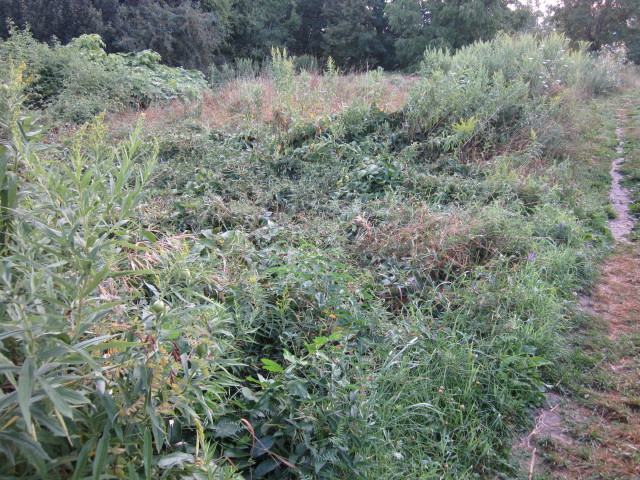
A tour around the Butterfly Meadow, site of the first two work bees, and the fields to the east we've been recently cutting revealed new growth already springing up. The BM has new plants coming up and in the field, cut stems are sprouting vines at their leaf nodes. It was discouraging to see long stems with as many as 8-10 nodes, each with a vine coming on.

Saturday, August 13: Geoff was unable to make the Sunday work bee so came in this morning instead. He continued scything around the row of tamaracks, working his way in the direction of the Ash Woods and again producing a large heap of cut DSV.

WEEK 15, August 9

Volunteers: Barry, Geoff, Glenda, Christine, Marg

The idea was to start in the first of three fields north of the Ash Woods, the one on the west side of the trail that runs along the west side of the Woods then curves around to the east. Geoff worked in this area, starting just below the curve and working his way around it, ending up on the east side of the row of tamaracks that separate this shrubby area from the middle field.

Glenda and Barry intended to work directly with Geoff but discovered that there was a good deal of DSV in the southern end of the field worked on last week. Glenda continued working there, pulling copious vines out from among the sumacs and other bushes, while Barry worked in even denser ground across the trail from her.

This is the transition point, where the Ash Woods ends and the dense shrubs and trees of the new work area begin. The scythe reached its limit in this area, and the clamp holding the blade to the snath fell apart. It was a hard day for tools, as Geoff found his rake in pieces too. The good news was discovering that a pitch fork is a pretty handy device for stacking cut vines. After a hard morning's work, Glenda stayed behind to take photographs for the blog.

Christine and Marg continued in the Old Field, weeding DSV out from among the beneficial plants in the northeast corner. At Christine's suggested, the decision has been made to mow half of the Old Field at the end of the season, i.e., in October, but the area to be mowed does not have a lot of DSV in it. The other half will be mowed in October 2012.


Monday, August 15, 2011

SUNDAY, AUGUST 14: THIRD BLITZ DAY

Having a work bee is a bit like throwing a party without an invitation list - hard to know how many will turn up. The numbers were down somewhat, 15 instead of the couple dozen we averaged in the first two bees, but still a solid turnout. And people worked very hard, most staying for three hours til noon and several for the full four.


We worked along the Bill Holland trail, the goal being to get rid of the DSV climbing up into the sumacs. Many of these vines were reaching heights of two metres and more and full of pods that would have soon been releasing seeds. The section from the Interpretation Centre to the main sign at the parking lot is now pretty much free of DSV.

A dozen people worked this area while Tony Denton and two others went into the ravine below the nursery to work on DSV down there. The ravine harbours a good deal more DSV than realized, being out of sight and mind unless one makes the trip down. In addition to a number of bags of DSV being hauled up, Tony freed a hawthorn from the dual affliction of DSV and wild grape.
Where's Waldo Hedrick?
Along the South Side of Bill Holland Trail - Before the Work Started
Along the South Side of the Bill Holland Trail After all the Hard Work

Along the North Side of Bill Holland Trail - Before the Work Started

Same Area after lots of Muscle Power

The success of this third effort is demonstrated by some 40 bags of cut DSV plants, piled on top of several wheelbarrow loads of loose cuttings - the equivalent of about 45 bags. This is a huge amount, probably the most yet for a blitz day this year or last. Well done!


See more pictures here.

Monday, August 8, 2011

Friday August 5 and Saturday August 6


Friday, August 5: Barry photographed the work done on Tuesday, apart from the piles of DSV, already removed by AAFC.  He continued scything the area on the south side of the ravine that he and Geoff had started, working around the trees and down the upper slope of the ravine until stopped by a large stand of flowering raspberries.

There seems to be little DSV further into the ravine beyond this stand, although clumps of DSV appear at other places. The area between the mystery circle and the walnut tree is now mostly cleared, but some mop-up is still required, including raking up and stacking the cut plants.


Saturday, August 6: Geoff came in the morning to work just west of the mystery circle, clearing out the area bounded by it, the east-west trail and the sumac stand. His photographs of the work done include an impressive stack of cut DSV!

BEFORE

AFTER

AND, HERE'S WHERE ALL THE DSV WENT!

We are now ready to move east, to the three areas north of the Ash Woods. The first of these, between the north-south trail and the line of tamaracks, is in pretty good shape, there being so many trees, bushes and other plants that the DSV is pretty well confined to the out perimeter - or so it seemed on first look on Friday. The other areas are heavy with DSV which has climbed into the many scattered trees and bushes. Sandy pointed out a black-and-white paper wasp nest in one of the trees near the trail. We will need to avoid this, as this species will attack aggressively if disturbed.

Two more work bees have been scheduled, for Sunday August 14 and Sunday September 11.  Notices are being put on the website and in the upcoming newsletter.

Saturday, August 6, 2011

Another Weeding Bee!

We had SUCH a great time and accomplished so much during our July weeding bees that we want to relive the experience on August 14th (Sunday).
 
Please come and help!

Not sure?  You can find out more about one of the July Weeding Bees we had and see how much fun everyone had.  Well, I think everyone had fun, but if not fun, then at least a great sense of accomplishment. 
 
No need to work ALL morning - an hour or so would be much appreciated. There might even be an opportunity to try out a scythe if you look serious and responsible and stay away from everyone else.

Bring: Gloves, long sleeves (some people get a mild rash from Dog-strangling Vine), water, sun protection

Where: Meet at the Interpretation Centre, just past the roundabout going south on Prince of Wales Drive.

Come on out and see how big a DSV pile you can make.


Thursday, August 4, 2011

A Hero in the Battle of Invasive Species

As bad a Dog-Strangling Vine (DSV) is, we have to be so grateful that Kudzu is not a problem in the Ottawa area.  

Kudzu is a terribly aggressive invasive in the US and now in some areas of Canada (e.g. Lake Erie).  Originally from Japan, it was once thought to be an erosion control solution in the States.  Now, it has gotten out of control.  It grows up to 30 centimetres a day, blanketing everything in its path, including hydro poles, fences, houses and highway signs.  Control has been extremely difficult and expensive.   

And now, here is a 16 year old guy with a solution, the "Kudzu Kid".    Originally, Jacob Schindler had hopes of making his mark by growing Kudzu on Mars.  When he realized that wouldn't work because of the amounts of helium on Mars, the wheels started turning and he tried injecting helium into the tuberous roots of Kudzu.  Zap.  Success.  Patents are pending.  Experiments are running.  Looks like this is working. 

Maybe Jacob will turn his mind to DSV?

Friday, July 29, 2011

WEEK 13, July 26

Volunteers: Barry, Geoff, Glenda, Hedrik, Christine plus 7 members of the Heffner family.

The Heffners joined us this week, volunteering as a means of off-setting the environmental costs of their trip from Michigan. This is an admirable idea and they were with us for about 2 hours, until our morning got called by an incredible thunderstorm. The Heffners worked along the part of the Bill Holland trail closest to the IC and on the ravine side, then moved briefly to the field east of the Butterfly Meadow. Their main activity was clearing DSV from around and in the trees, sumacs along the trail and cedars in the field.


While Barry was with the Heffners, Glenda, Geoff and Hedrik returned to the Green Heron road to continue last week's work, along the road toward the Butterfly Meadow. AAFC had picked up the stacks of DSV cut last week and now have more to pick up.


Christine continued her work in the Old Field and also along the fence on the north slope of the Amphibian Pond.   Geoff then switched to the field east of the Meadow.  Glenda and Barry and the Heffners joined him there for the last half hour. We made good progress on this field and we should be able to finish it next week. After that, it's on the fields north of the Ash Woods.


Wednesday, July 27, 2011

The Heffner Family Gives Back to the Environment


This week we had the pleasure of having the Heffner family from Grand Rapids, Michigan work with us in our efforts to control Dog-strangling Vine (DSV).  Pictured above are Ken and Gail Heffner with Daniel Heffner, Andrew Heffner, Morgan Stewart, and Elisabeth Heffner. 

The Heffners were in town on vacation, visiting son Daniel who is a grad student here in Ottawa.  Aware of the environmental impacts of their travel, they try to offset these when travelling by giving back in some way to the community they are visiting. 

They found out about the Fletcher Wildlife Garden (FWG) and the struggle to control Dog-strangling Vine.  DSV is a highly invasive species that thrives in sun or shade and in any type of soil.  It spreads rapidly, choking out other plants and even trees in the area.  It is pervasive throughout FWG, and volunteers have been busy trying to control the spread of seeds and stem the spread of DSV into areas that are not yet heavily invested.

Upon arrival, the Heffner family enthusiastically got suited up with work gloves and dug right in, so to speak!  


In the couple of hours they gave to FWG, they were able to make a real difference.  First, working along a busy pathway and then moving on to an open area where they were able to free up several trees and shrubs that had been covered with DSV.   We all watched the dark clouds coming in and they gamely kept right on working up until the clouds broke.  Torrents of rain soon came down while we took shelter in the Interpretation Centre.


At FWG, no matter how much hard work is to be done, there is always time to see some wildlife and learn from the many knowledgeable nature lovers around.   Among other things, the Heffners were able to observe a young Green Heron at the Amphibian Pond (photo below) and a crab spider that has been hanging out on a common milkweed plant.   


The Heffners set a wonderful example of environmental stewardship and community involvement.  What a great way to give back when visiting friends and family out of town.  Many thanks to the Heffners and safe travels to you all!